Wednesday, July 23, 2008

Keepin' On Rollin'

Quite a bit of time has passed since my last update, though little of note has happened. My meetings in Shenzhen and Hong Kong did go off without a hitch, and both of them proved pretty useful. After spending yet another rainy day in Hong Kong, I made the flight to Hangzhou, where I was to have one of the last of my meetings. Well, one thing I've had drilled into my head this trip was that I can't count on anything to be an absolute certainty in China, so when push came to shove, the professor I was supposed to meet in Hangzhou decided that he couldn't meet after all, and he just simply stopped responding to my emails. NICE. Nothing more enjoyable than flying to a city for no reason.

I did visit a friend from Vanderbilt while in Hangzhou, and my Chinese professor from uni happened to be in town, so I was able to have dinner with her. She was intimidating woman from the time I met her, so I had actually been dreading the chance of running into her back at Vanderbilt this fall; I was one of her most promising students when I took her class, she let me know, and I thought she had always been disappointed by my decision not to enroll for the second semester; add to that the fact that I had lived in China for a year, and I thought I was doomed to remain a disappointment in her eyes, as there was no way I could have lived up to her expectations without studying Chinese diligently while living here. Well, I guess most of my fears were unfounded. My Chinese is still something I'd like to improve, but we talked for two hours in Chinese before switching to a mix of Chinese and English, and she told me she was pretty happy with my speaking level; we may even meet informally when I return to Vanderbilt so that I can have some practice every now and then.

After a couple of days in Hangzhou, which is known across China for its centrally-located West Lake (Xihu) that proves a nice area in which to relax, I took the train back to Jiaxing, where I slept my first few nights this trip. Julie's sister, Jamie, had arrived from Korea, on her way to Vietnam before coming back to live in China, so I thought it would be nice to take some day trips around Shanghai (and hopefully have one more meeting with an NGO that had warmly invited me to visit them this summer, but we all know how that ended up) with her. Unfortunately, I got quite sick the second day I was there and had to spend the next 4-5 days on the couch. The first day I felt like traveling again also happened to be the day Jamie departed for Vietnam, so I probably didn't leave the best impression. I learned how to say "constipation (a secondary symptom) in Chinese, and I pantomimed my way through "non-oral medication". A few days later I had to return to the pharmacist to get some medication for Julie's sore throat and ears, and I had to make extra sure that he did not think the two conditions were related.

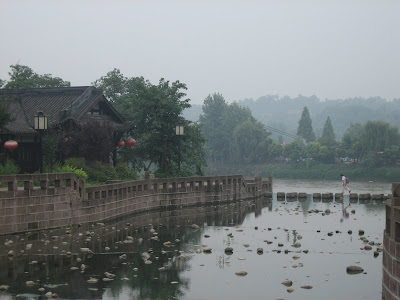
Hangzhou's Xihu (and pollution):


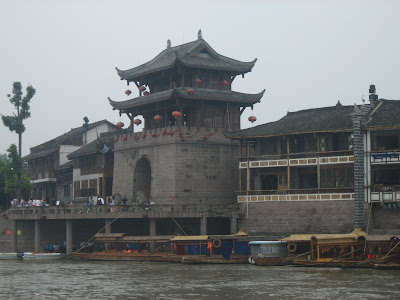
Part of Rory and Julie's apartment complex in Jiaxing:


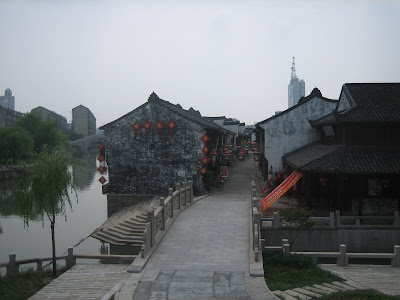
Old town in Jiaxing:


This past Saturday, I departed Shanghai again for Weihai, where I lived for the year in 2006-2007. Most of my friends have moved away, but the ones that remain were some of my best friends in China, so it was still a much-anticipated trip, as I'd also have the opportunity to relax on the beach for a few days. Indeed, I have done a lot of relaxing, though most of it has occurred indoors since the weather has been unseasonably cool and wet. A few of the places I had hoped to visit have closed in the year I've been gone, including my favorite massage place, so I need to fine a new place willing to give me a 90-minute massage for $7. I have enjoyed the Korean spas a couple of times, and former students have invited me for dinner a couple of times. It's hard to believe that I have only three more nights in China, and then I'll be back in the US, ready to start the whirlwind of a month that will see me make the move again from Atlanta to Nashville.

Tuesday, July 08, 2008

Jetsetter

I'm in Shenzhen now, my third of five cities in four days. I flew from Urumqi to Beijing two days ago, and I discovered that it's possible to walk to the airport in Urumqi. I found a city bus that would take me the two hours to the airport for only $0.14, but I guess it decided that a mile away from the airport is close enough. But seriously, if you're going to go all that way, why not go the last mile? It's like running a marathon and giving up after 26 miles because you don't want to run the extra 0.2 miles. So, after realizing that I was not yet at the airport, I assessed my options: pay a cab, thereby defeating the purpose of the bus, or walk. Nearly everyone decided to talk, so I joined them. Unfortunately, my digestive system has not been operating as efficiently as I would like as of late (read: every four days, on average), and right as I started the walk, my stomach started making that grumbling noise that indicates you better find a bathroom fast, so I run-walked the last quarter of a mile.

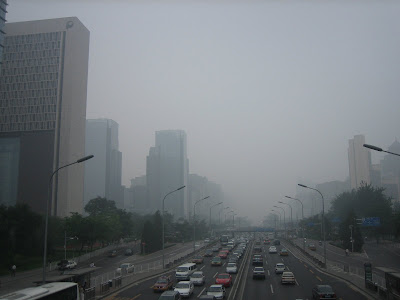
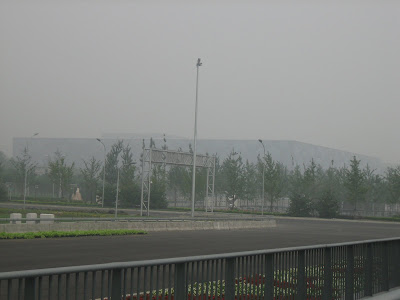
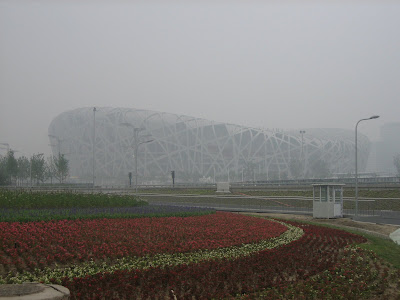
Originally, I was to have three meetings in Beijing, but two of them canceled after I had made my flight. One of the cancellations I would probably get to see later in Hangzhou, though, so really I was only going to miss one of the meetings. Well, by the time I got to Beijing, the third person had canceled, and the professor I was supposed to meet in Hangzhou had mysteriously come back to Beijing, but was now too busy to meet. SO, basically, I paid a lot of money to fly to Beijing for nothing. The air was horrible, and that, or the four hours I spent at the pearl market, gave me a nauseating headache by the end of the day that was only cured by bootleg Will and Grace DVDS at a friend's apartment. The air quality is certainly no better than it was last year, so a lot of work is yet to be done in order to get the city ready for serious athletic competitions.

Beijing:


The Water Cube, aka Olympic Aquatic Center:


The Bird's Nest, aka Olympic Stadium:


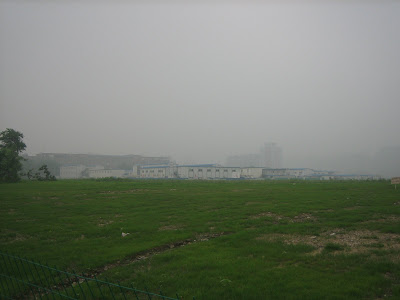
Housing for all of the migrant workers used to build the new structures:


Right now I'm in Shenzhen, just across the border from Hong Kong; I have a meeting in an hour, and I'm trying to make sure another one in Hong Kong doesn't fall through, since I refuse to come back a third time. Tomorrow I hope to fly from Shenzhen to Hangzhou, where the last of my meetings will take place (if all goes as planned, though my flight seems to have been changed, so let's just go ahead and throw that possibility out the window, too).

Monday, July 07, 2008

Desert vs. Dessert

My week in Xinjiang has been a series of ups and downs. When I booked my flight, another couchsurfer had planned to join me for the trip, but financial difficulties resulting from a series of miscues--missed trains, forgotten passports, etc.--forced him to cancel on me. As much as possible, I tried to meet new people along the way, starting with a few Swiss Germans, two Belgians, a Frenchie, an American-Frenchie, two Japanese, a really obnoxious Canadian, two American frat boys, two British sisters who had never flown before, an English mother and son, and Germans with and without socks for their sandals. I have also been staying with Akbar, a friend of Tyler's in Xinjiang. The company was more than sufficient until yesterday, when the perfect Chinese storm synthesized from the volatile elements of transportation and tourism.
About a week ago, I flew from Chengdu to Urumqi, capital of Xinjiang Autonomous Region in China. Xinjiang and Sichuan, where Chengdu is located, were two of the places I most wanted to visit in 2006-2007, but I ran out of time and money. Luckily, all of my other plans fell through and flights to both were cheap this summer, so I suppose I now need to come up with some additional places worth exploring. Tibet would certainly make this list, but it's massively expensive with all of the rules and regulations of the Chinese government. Anyhow, I arrived in Urumqi, not known for much beyond being a transportation hub, and shared a cab with the Swiss Germans to the hostel, since all of my potential couchsurfing guests had fallen through, where I promptly met another Swiss German, with whom I went out for dinner and a beer. Xinjiang is an interesting place for a number of reasons, the least of which is its absurd time zone classification. The Chinese central government operates the entire country under one time zone, so in the West, which is more than 3000 miles from and closer to Kazakhstan and Pakistan than Beijing, the sun effectively rises at around 8:30am and sets around 9:30 or 10:00pm. Of course, the locals operate on their own time, two hours behind that of Beijing, but that just means that you always have to stipulate which time zone you're referring to--Beijing time or Xinjiang time. It gets pretty confusing if you're not paying attention, and it makes you second guess yourself whenever you set a time for something.

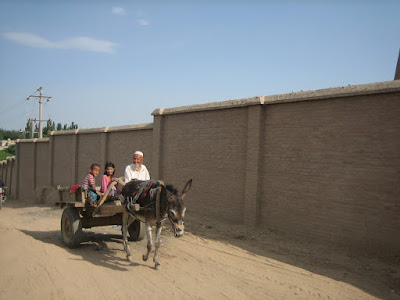
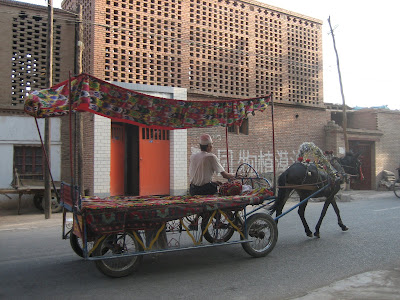
Returning from the tangent now, I decided to leave Urumqi after only one night for Turpan, because Turpan has a number of compelling reasons to visit, and because I didn't want to save that visit for later in the week, get trapped without transportation, and not be able to make it back for my return flight from Urumqi. So, the next day I took a bus to Turpan, which was regularly over 110 F during the day, and latched on to the first foreigners I saw, since I wanted to hire and share a car for the next day to visit some sights, and because I didn't want to be stuck eating dinner alone, since not too many foreigners make it this far north and west. My communication has been limited, especially in the heavily Uighur areas like Turpan, so chatting with the locals was less of an option. In this case, the Belgians and Frenchies were the lucky ones, and I made a decent effort in the Yahtzee that they had continued from their 24-hour train rides from the day before. The actual city of Turpan has little to do beyond its bazaar, which was more impressive for the people watching than for what was offered, so I rode a donkey cart into town to search unsuccessfully for a karaoke joint with the Brits and Frat Boys, before heading to bed.

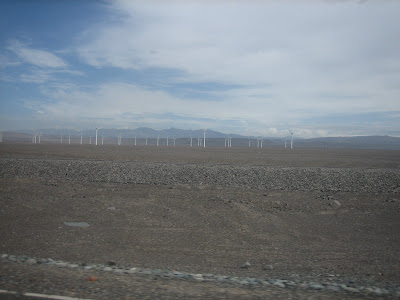
Wind farms in the desert:


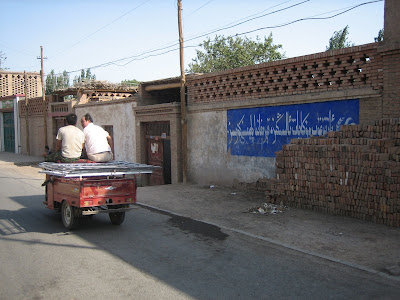
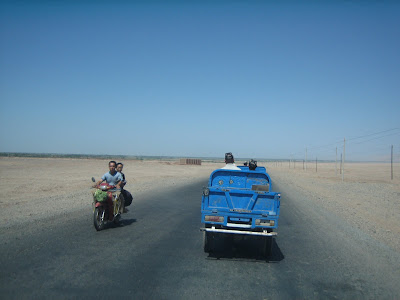
Common mode of transportation:


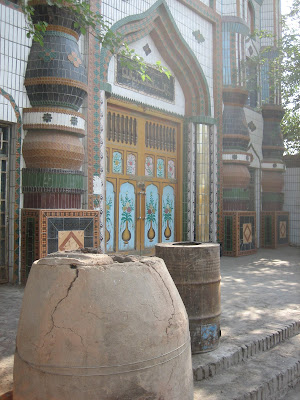
Mosque in the old part of town:


Another mosque:


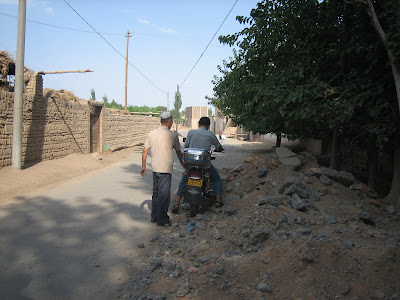
These guys had a little accident when they took their eyes off the road to stare at the foreigners walking through town:


Donkey and Uighyrs:


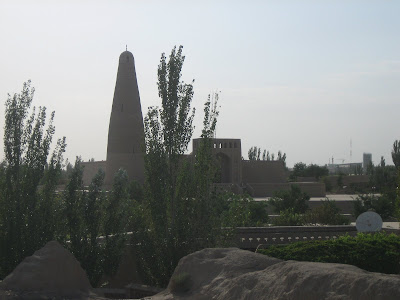
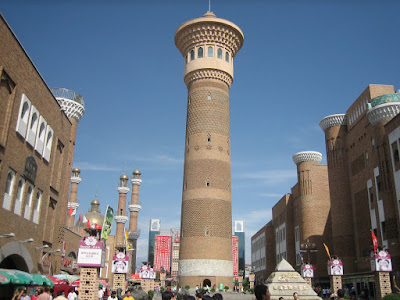
Emin Minaret in Turpan:


Our mode of transportation to look for a karaoke joint in Turpan (the structure behind the donkey is used for drying grapes):


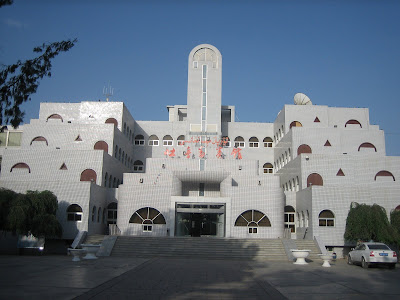
My hotel (my dorm room was in the basement) in Turpan:


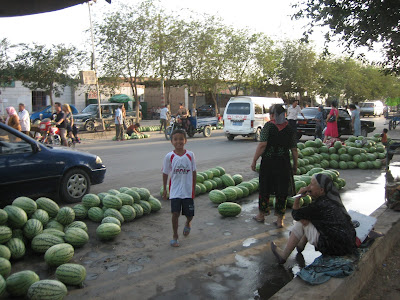
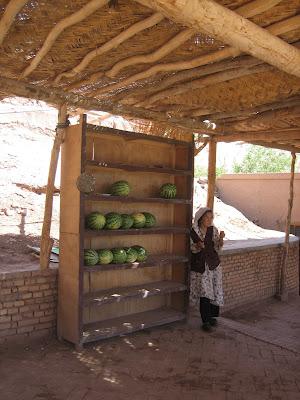
Watermelon alley at the bazaar:


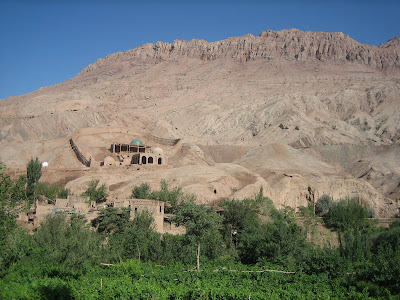
Our car departed the next morning at 7:30am, and we were luck to arrange with the driver which areas we wanted to visit. We intended to avoid what had been described as tourist traps by many guides and other travelers, but dedicate extra time to those places that really had something to offer. First on the itinerary was the village of Tuyoq, set in a valley beneath caves dating from 400 AD. This place was incredible, really an oasis in the hot desert; the cemetery on the edge of town that was at least 1000 years old was especially interesting. It is said that this is considered seen visits to Tuyoq equal one visit to Mecca, as this is the resting place of one of the Uighur forefathers, and also perhaps because virtually none of the Uighurs has the resources to make it to Mecca. We did have to argue for 20 minutes before we allowed to depart, though, since we decided to eat the ice cream that had been offered to us, despite our Strong resistance, rather than let it melt. Unfortunately, as the government has limited travel in the region and to the country as a whole this summer because of the Olympics, the town has seen an enormous drop in tourism, but the few people I chatted with did seem optimistic that order would return in time for next summer.

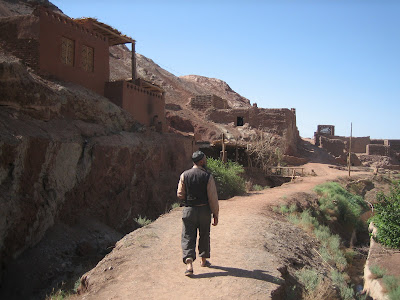
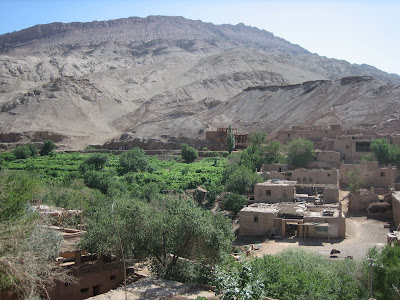
Tuyoq:


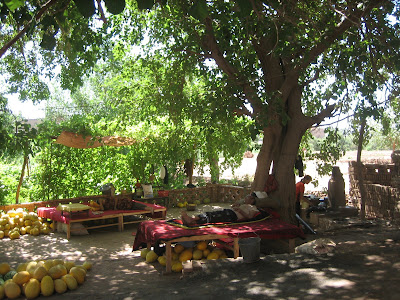
Watching over the melons:


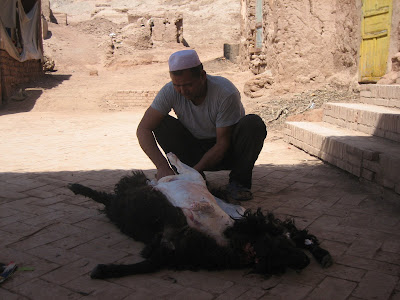
Skinning a newly-killed goat:


Chillin'-out, maxin', and relaxin' all cool:


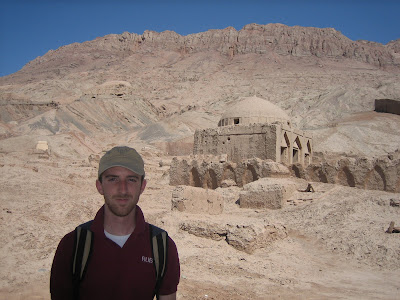
Damn it feels good to be a gangster. I know I look like a tool, but I thought some protection from the desert sun would be wise:


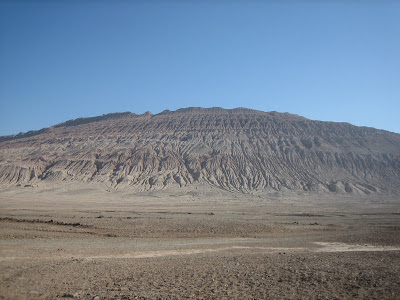
After Tuyoq, we drove by an abandoned city (less impressive than the one we'd pay to visit later in the day); some ancient burial grounds, most of whose remnants have been relocated to museums elsewhere; and incredibly overpriced irrigation systems that are on display for free throughout much of Xinjiang. We also drove by Flaming Mountain, which the local authorities have tried to turn into a tourist attraction by fencing in a few acres in front of the mountain and filling them in with statues and amusement rides, despite the fact that the mountain can be seen for countless miles around. As I've noted before, this is one of the maddening things about China: taking something pure and simple and trying to make it into something more grand, in order to make a buck. Entire old cities can be razed with the hope of producing a picture-perfect village that tourists might want to visit, even if the new product contains nothing true. At the Great Wall section of Badaling near Beijing, the same thing is true, as if the Wall itself if is not enough reason to visit. And, it would be true a few days later when I decided to visit Tianchi.

On the road again:


Flaming Mountain:


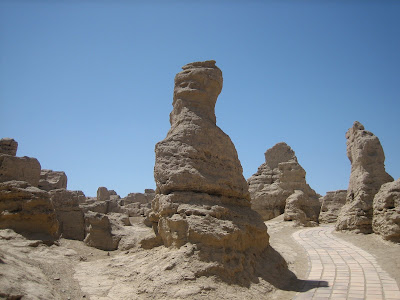
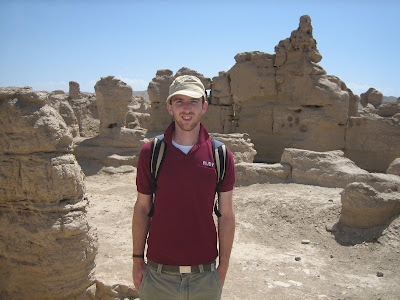
After a delicious lunch in Turpan, we departed for the other side of the city, to walk around the ancient city of Jiaohe, which was once an important stop along the Silk Route. It's unfortunate that I can't post pictures now, though I promise to do so in a week or so, because this place really was one of the top five things I have seen in China, and the government hasn't done too much to spoil it, other than the ubiquitous security cameras to make sure you don't wanted off the paths and contribute further to the erosion of the city. Street plans and walls of up to about 20 feet are still evident in some places, and even back then it likely would have taken an hour to traverse across the city. Exhausted from the day's sights, I collapsed back at the hostel for a nap before eating dinner and retiring for bed.

Jiaohe:


The following day, I took the bus back to Urumqi and met Tyler's friend, Akbar, in time for lunch and dinner. A Uighur-version of friends back home, he's been cracking jokes since I met him and has made my stay in Urumqi much more enjoyable. He's also been a valuable lens on the Uighur situation in Xinjiang. Like many other minority areas in China, the government has adopted the practice of aggressively encouraging Han majority people to rapidly populate minority areas, thus suffocating minority presence and culture and simultaneously minimizing the possibility of minority protests/movements against the majority. Minority peoples then experience trouble in getting a job, as they are either discriminated against or lack the Mandarin language faculties necessary to gain proper employment, and thus starts the cycle of generational poverty. Even in heavily Uighyr areas of Xinjiang, I noticed countless youths and people of working age just sitting on the streets with little to do. Despite this, Akbar does seem optimistic about the future when I asked him about it. He is a college professor, though, so perhaps this is not the most accurate reflection of current Uighur thought.
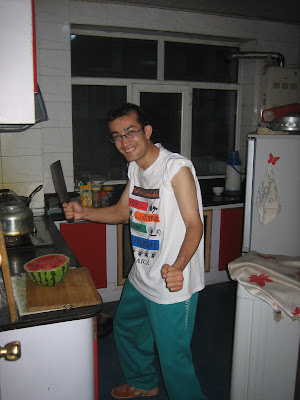
Akbar about to destroy a watermelon. Actually, the traditional Uighyr way of eating the watermelon is to cut it only into quarters and then eat it with a spoon (as opposed to our thinner, messier slices):


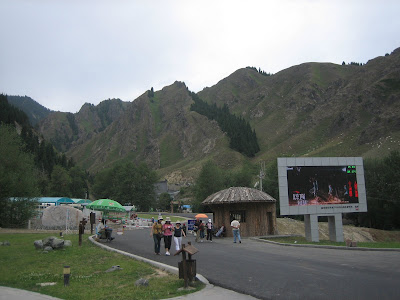
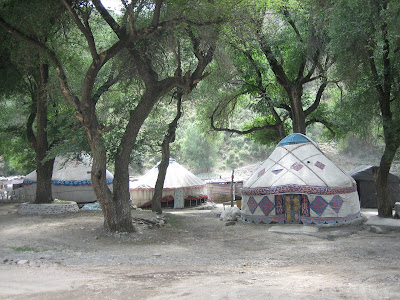
The next morning (I lost track of days and dates a long time ago) I took a few city buses to the entrance of People's Park, hacked my way through tour touts, and eventually found my way upon simple buses to and from Tianchi, also known as Heavenly Lake. I had looked forward to the trip for days, as it would be a welcome alternative to the arid climate of Turpan, being described by some as China's version of Switzerland. I planned to stay the night in a Kazakh yurt (tent) along the lake and under the shadows of the 20000ft mountains, but I did not anticipate the commercial adulteration I would encounter at the site. A giant, loud, outdoor big-screen television and amusement rides greeted me at the entrance to the valley after I had paid the ridiculous entrance fee, and from there I had the option of walking up the mountain or paying another ridiculous fee to take a cable car or bus to the top of the viewing area. I chose to take the one or two thousand steps to the top, and apart from the Chinese field trip groups, the scenery was left fairly untouched. When I reached the top, however, where I could be joined by those less outdoors-inclined, I felt like I was in at Disney World. Loud music was blasting from numerous speakers, ugly boat ramps had been installed to make a few extra bucks from tourists, and no one really seemed to care that they were in a place that should have been revered for its beauty. Now, my experience with Chinese outdoor/nature experiences has been that the picture is worth more than one's actual experience in nature, and this occasion be the model for such an assertion. I was pretty disgusted and decided not to stay the night and instead hike down as quickly as possible and spend the night back in Urumqi. This meant that I had to find other transportation back, since I had told my bus that I would not be returning that day and they had found someone else to take my seat, so after about fours hours on mostly dirt roads, and a thick layer of dust on my belongings and in my mouth, I made it back to Urumqi. After another hour getting lost on city buses, I made it back to Akbar's apartment, waited a few hours for him to get home, and then crashed in bed.

Giant, loud TV at Tianchi:


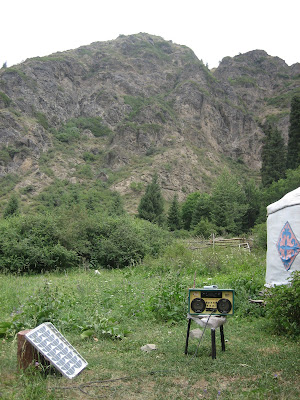
Solar radio in the middle of nowhere, Tianchi:


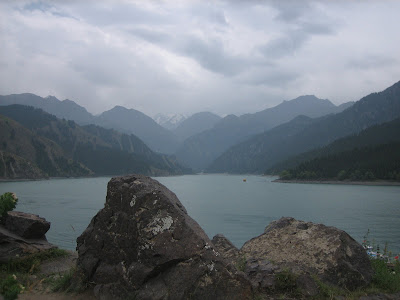
Tianchi (I've covered up the ugliness with the rocks in the foreground):


Traditional Kazakh yurts:


This morning I spent a few hours trying to arrange flights for the end of my trip (again, transportation here: sucks), before doing some shopping at the enormous, and impressive, International Bazaar, which bodes well for some of you. Tomorrow I head to Beijing for a meeting and some shopping, before heading BACK down to Hong Kong for a couple of meetings, and then back up to the Shanghai area and Weihai for the final two weeks with people I actually know. You can't imagine how great that will be after almost three weeks by myself.

International Bazaar:

Monday, June 30, 2008

Hot and Spicy in Sichuan

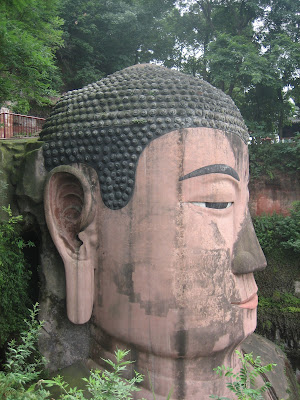
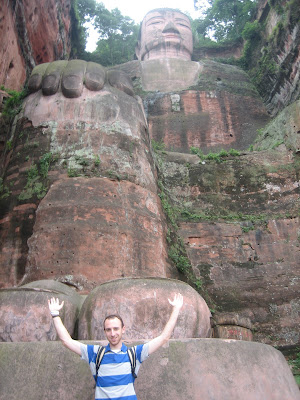
Since I last wrote, I have spent the last of my full days in Chengdu and the surrounding area. After I arrived, I took a two-hour bus to Leshan, site of the world's largest carved Buddha at more than 20 stories tall. Luckily, I encountered two Israelis during the eighth month of their Southeast Asian romp, so I spent the day exchanging stories with friendly strangers rather than becoming bored by my own thoughts. Perhaps the strangest aspect of the site was the lack of Chinese tourists. It was actually possible to take pictures around the Buddha, and I only had to pose for a few pictures with the Chinese tourists. Normally, the place would have been packed beyond belief, but tourism in the area has been severely depressed since the earthquake, up to 90% off last year's levels, I am told. Certainly this will not help the area recover quickly, but it does make for nice vacationing.

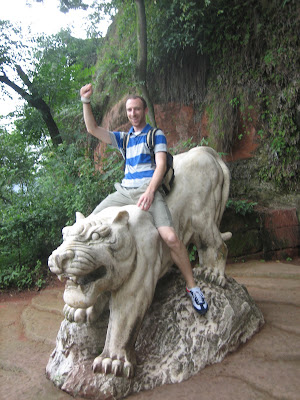
Ride that tiger:


Big Buddha, Big Buddha, Big Buddha Big Buddha Big Buddha:


The girls with whom I'm couchsurfing had invited 1-2 more surfers to stay at their place while I was there, and they arrived later that night. This proved to be a fortunate development, as it provided me with travel companions for the ensuing few days.

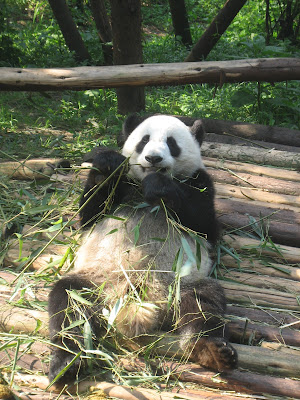
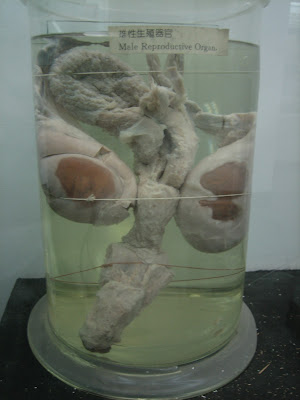
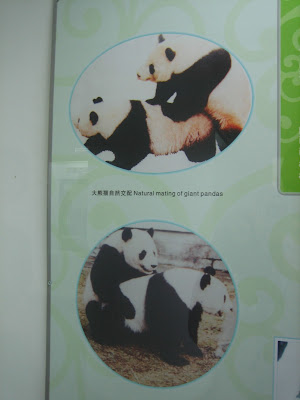
Jordan, from Arizona, went with me to view the Panda Research Centre outside of Chengdu the next day. Unfortunately, many of the pandas have been moved to Beijing as a result of the earthquake, so we only saw about 15 total pandas, as well as preserved parts of dead pandas. Truthfully, I don't understand how pandas are not yet extinct. They sleep for about 21 hours per day, making them incredibly vulnerable to attack; they essentially only eat one kind of vegetation, meaning that they are incredibly dependent upon only the most ideal living conditions; they aren't sexually mature until they're around 6 years old, meaning that there's a significant chance they won't even survive to reproduce; if they do survive that long, they don't seem that interested in mating during the 3 hours a day they're lucid, so much so that zoologists often have to show panda porn in order to get them interested in one another; they normally only raise one offspring, leaving the others to die; and they often decide to kill and eat this offspring if they don't like it or want to raise it. With 1000 or so left in the wild (meaning nature reserve in remote Sichuan), don't expect them to ever fully recover.

Just munchin':


I'm pretty sure this quotation didn't originally refer to pandas:


Reproductive organs:


Rare shots of pandas willingly mating:


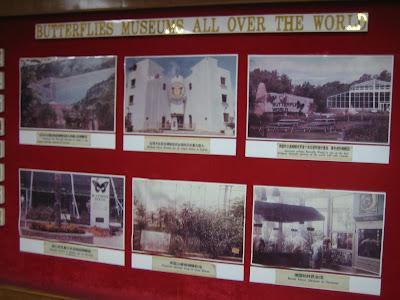
A museum exhibit in the panda museum about other museums (you might even say, a meta-museum):


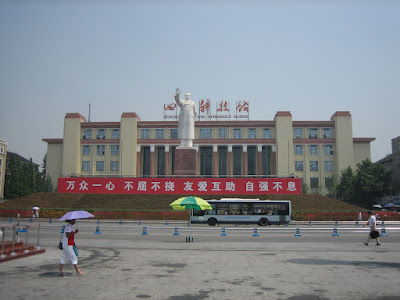
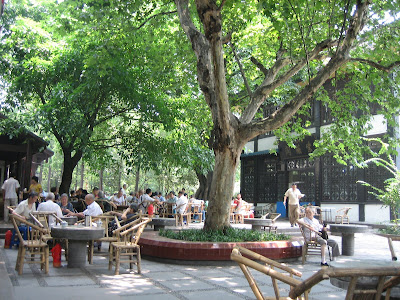
After getting back from the panda reserve before noon, since they've all passed out from bamboo ecstasy by 11, Jordan and I made our way to the central square, dominated by an enormous Mao statue, and then continued on to People's Park to relax in one of the teahouses made famous by Sichuanese dwellers. If I were to move back to China, I would not consider living anywhere other than the provinces of Yunnan, Sichuan, or Guangxi in the south. The life here just seems so much more relaxed. Locals young and old spend hours chatting and playing cards and mazhong with one another, with nothing more than a $0.60 cup of tea required, and I don't think they're bothered at all by the decrease in productivity.

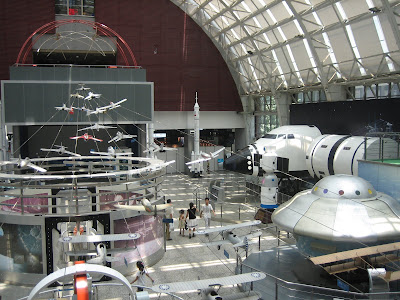
The next day we ventured to the Sichuan Science and Nature Museum that we had noticed behind the giant Mao statue, and it was glorious. Just like its equivalent in Chicago, it featured decades-old computers and exhibits. Unfortunately, they also had toys that apparently weren't suitable for grown-ups, as another couchsurfing friend, Thomas, decided to stick his finger in one of the apparatuses, which promptly resulted in a fractured finger that had to be numbed by tubs of ice cream until he eventually made his way to the hospital. Jordan and I continued on to the Tibetan area of the city (parts of Sichuan and Yunnan were previously considered Tibet before China gained control of Tibet in the mid-twentieth century, so that current political lines do not accurately incorporate Tibetan areas in Tibet with those in other adjoining provinces) to look for some of the food that had been so delicious when Tyler and I traveled to Yunnan. Unfortunately, no yak cheese dumplings were to be found, though I suppose the yak meat was tasty enough for the trip to have been worth the effort.

Mao in front of the museum:


Inside the museum (notice the UFO on the right):


Tea house:


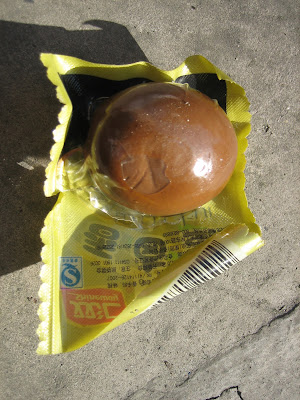
Gross 1000-year old egg:


NICE!


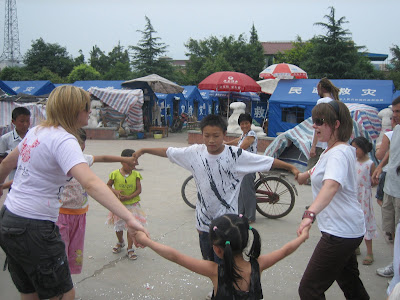
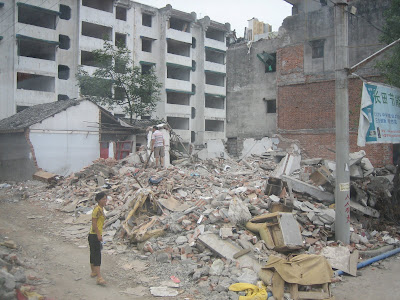
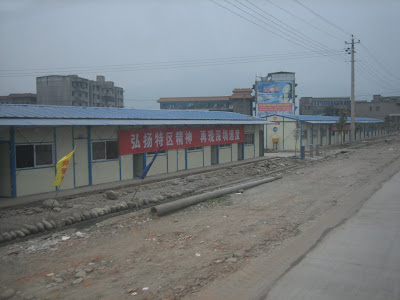
As I wrote in my initial post this year, I planned to spend some time on this trip in areas affected by the earthquake. As I anticipated to some degree, this has proved difficult. The government, understandably, does not want foreigners to circumvent its control. Pictures of areas that have not yet been adequately responded to, and pictures of foreigners providing support instead of the government, are to be particularly avoided, I imagine. This, along with the more-than-sufficient manpower enabled by a country of 1.3 billion people, meant that I certainly wouldn't be hoisting bricks or painting newly built walls. I thought my year as a teacher might be of some use, and indeed I had lined up a gig teaching for about a week in a rural township, only to have those plans fall through. I had also found a foreign organization needing help putting together medical kits, but that project was dependent upon the supplies arriving in a timely manner, and this did not happen at a time when I was free. Fortunately, an organization formed by expats after the earthquake has been traveling to a more remote, devastated village each Sunday simply to provide a break for the kids and families. I was invited to accompany them this Sunday, and I assumed I'd be teaching some English classes to the schoolchildren. This, along with song and dance, crafts, recreation and sports, and preschool, form the groups the organization plans each week to support the kids. After it was discovered that I had spent time in Nashville, though, I was quickly placed on the song and dance team to teach some line dances and see if I could get some boys interested in that activity. I thought about some of the different moves involved in line dances, and even some that normally aren't (per Tyler at the Wild Horse), but ultimately I sort of just made them up on the spot when we arrived in Loushui. Never have I been so tired after only half an hour! Russian leg-kicks, hops, slides, steps, spins, heel kicks, twists, and turns in sunny 90-degree heat can really take it out of you. When we first arrived at the village, I was concerned that our presence was a bit self-indulgent and unhelpful to the community, as locals stared at our bus and police refused to let us enter. But after some wrangling with the authorities and spending a few hours with the kids, I know that they were glad to have us there. The town is pretty devastated, with people living in tents and few buildings safe to inhabit or enter, but it has seen a pronounced increase in local commerce this past week, according to some of the more consistent volunteers, so hopefully that is a sign that life is beginning to return to normalcy.

Playing games with the kiddies:


Standing in rubble:


Temporary housing for the army and relief workers:


Today, I made my way to Huanglongxi, one of the sites used for the filming of "Crouching Tiger, Hidden Dragon". It was a fairly touristy Chinese site, but I did sit for three hours in a tea house and read through most of one of the books I brought. I was also reminded again of why I hate minibuses. I took one this morning without much trouble, though the 90 minutes it took to travel 40 kilometers were a bit excessive. As I departed the bus, I was told by the attendant that the bus would be leaving at 3:00. I made it back to the bus by around 2:30 and ate a quick lunch, and I was on board by 3:00. Well, 3:00 doesn't mean 3:00 in China, but rather "whenever the bus is full of people and live chicken after 3:00, or, more precisely, 3:50. This wasn't too bad, since I was just having a relaxing Sichuanese day and wasn't feeling rushed, and the bus would be taking me directly to a bus station right on one of the local Chengdu bus routes back to the apartment I'm staying in. Well, I dozed off on the bus, only to be awakened by some yelling that we had arrived at the stop, when in reality, we had arrived a few blocks away and the bus wanted to continue on a different route. If I hadn't woken up then, who knows where I would have ended up. And if I couldn't speak Chinese, I never would have known that the plans were changing in the first place. Oh, China.

Huanglongxi:


Tomorrow, I head to the last frontier in China, also known as Xinjiang. It's mostly desert, so I'll just continue sweating from sun-up until sun-up.

Where I buy all of my underwear in Chengdu:

Wednesday, June 25, 2008

The Perfect Storm

So, as it turns out, living in a secluded village on an island isn't ALWAYS that awesome especially if there's a typhoon (er even a tropical storm) in the area. ANd extra expecially if there's only one road to the village and it's impassible due to fallen trees and you have a flight to catch that's a 3-4 hour bus ride away. ANd super extra especially when fish from the ocean are blown into the village by the strong winds and left to flip flop and die.

A few days ago, I noticed a few signs posted with the message T-1, or Typhoon 1 (similar to our hurricane scale, though the typhoon scale goes up to 10). Nothing major, I thought. It was just a bit cloudy, but otherwise just a hot, muggy day. Te next day the signs said T-3. Again, nothing too alarming, I assumed. (I hadn't been checking the news at all, since I have to pay for my internet access, so these assumptions rested on little apart from my hope that my travel plans would not have to be altered.) Then, last night, after we had gotten back to the village, and as the winds started whipping up and rain started falling more heavily, this was bumped up to a T-8. I obviouly didn't sleep too well, and when I woke up, there was no public transportarion operating between the vilage and the rest of HK, and even private cars were unable to get out. Clearly, I would miss my morning meeting, and indeed when I called the office no one was present, as most of HK apparently took a day off, juding by the eerily empty metro. Eventually, one lane of the road was cleared, and I hopped on a (price-gouging) minibus to rush to the bus station to make it to the airport.

Because my cell phone was dead and my host did not have internet access, I had no idea where I would be spending the night, but luckily I have arrived in CHengdu with only an hour delay, and I was able to find another person via couchsurfing to host me. I'm still not sure how the volunteering will work out, but I will keep you updated. So far, I really like the city. As it's in the South, it has a natural tendency to be more relaxed, and this certainly holds true for Chengdu. It's a large city (5 million or more), but it has such a small-town feel that it's really not too intimidating at all.

I'll leave you with a quotaion I heard last night:
"He's the least Italian-looking, Japanese person in the world." Uh-huh.

Tuesday, June 24, 2008

Comings & Goings

Since last writing, I have taken a train to Hangzhou, flown to Guangzhou, and taken a bus to Hong Kong.

I met an old friend from Weihai, Neill, in Guangzhou. I'd heard good things about the city's nightlife, but Neill perhaps most aptly described its as a "Chinese Los Angeles." The city is sprawling and polluted, and it takes forever to get anywhere. Needless to say, I was not disappointed that I had only allocated one day in the city.
Guangzhou, with the second-most expensive rent prices in China (average around $2000/month):


The next day I planned to travel to Hong Kong. Anyone who has been to China or read about my experiences in the country knows that transportation is the most brain-hemorrhaging experience you can imagine. You almost always have a huge delay/layover (of multiple days) associated with trains; buses take 3x as long as they should due to their frequent stops and constant appeals for additional passengers; and flights deliver you to airports 60km from your intended destination with no cheap way to get you there. I read explicitly in my guide book that it was possible to buy direct bus tickets to HK from the Guangzhou main and east stations, but both times I've tried it, I've been laughed and looked at as thought I were an intelligent President Bush. Somehow it's more logical to have said buses depart from random hotels scattered throughout the city, and thus make them impossible to know about unless you're a soothsayer or encounter the uncommon travel agent who's willing to provide help even though the relationship is by no means symbiotic.

Similar things can be said for booking flights. One of the major travel websites recently began allowing foreigners to book flights online, but in order to do so, you have to fax or email copies of your passport, credit card, and travel agreement. If I'm going to have to travel to an internet cafe of business shop to use faxes, scanners, and copiers, why wouldn't I just eliminate a couple of stops and go to the travel agent directly?

And while we're on the theme of travel headaches, I witnessed another first a couple of days ago I've seen grown women and little babies pee and poop on the street; dogs urinate on bus floors; a baby uncontrollably expel diarrhea all over her mother on a bus; but I had never before seen a mother hold her child up, intentionally, willfully, and doodee-fully, over the middle of the train floor, so that the child could relieve himself. And then let the remnants flow around everyone's feet and belongings. Yay.

So, I'm already sick of the transportation aspects of travel, even though I'm otherwise having a fine time.

Moving on. I'm currently staying for a few days in HK. Last year I got out of the way most of the tourist stuff, so this time I decided to couchsurf with a guy who lives in a little village called Shek-O on the edge of Hong Kong Island (couchsurfing.com). He lives in the tiniest house I have ever been inside of; the kitchen is no larger than 15 square feet (this is for you, Jenna; pics will come soon, as promised), and we have to move all of the furniture to the perimeter of the living room in order for me to sleep. He sleeps on the floor upstairs and is unsure if there's room for a bed. Anyhow, the village might as well be situated on the Portuguese coast, because it doesn't feel anything like the hustling and bustling heart of HK.

I've had several; meetings today and have a couple more tomorrow with people with whom I might collaborate on future research, and they have been incredibly helpful It was a bit of an expensive detour to come to Hong Kong, as the city is more comparable to the West in prices than it is to the Chinese mainland, but it has been time and money incredibly well-spent.

Tomorrow I'll take a bus back up to Shenzhen, just across the China/HK border, and then fly to Chengdu, the capital of Sichuan Province, site of the recent earthquake.

I'm still not sure what I'll be doing, but at least part of my week or so in the province will be related to relief work. I've been invited to teach for a few days in a tent village, but nothing has of yet been confirmed. I also hope to find a day or two to see the largest carved Buddha in the world, visit the Panda Research Centre, and walk around the city used as a set for "Crouching Tiger, Hidden Dragon."

See/write to you in a few.
--Neal

Saturday, June 21, 2008

Arrival

I didn't bother with deodorant today. 1) The temperature is so hot, and the air so humid, that I'm sweating again even after I shower and before I leave to go outside, and 2) I locked myself out of Rory and Julie's bathroom this morning. ALso locked in said bathroom were items like my contacts and glasses, so I spent the better part of the day not really able to tell where I was going. It did make for the first adventure of the trip, though. After Rory and I spent about an hour this afternoon trying to jimmy the lock and in the process nearly breaking off a key while still in the keyhole, we went to look for a locksmith. I looked up the word in my dictionary before we left (suojiang), since I hadn't used it before, and off we went. I also learned another word during the search process, apparently the word used to refer to "man on little blue bicycle with lots of tools," because that's the person we came upon after asking for directions a few times. I have since forgotten said word, and I hope I never have to use it again. He walked his bicycle and tools with us back to the apartment and about 5 minutes and 60 yuan ($9, or way too much money) later, the door was open, my contacts were retrieved, and the bathroom was ready for business. (The internet I'm typing on right now, by contrast, costs about $0.37 per hour).

Let me back up a little bit. I arrived in Shanghai yesterday. On the flight over, I still wasn't sure where I planned to spend my first night, but I decided to stay outside of Shanghai with friends and fellow bloggers Rory and Julie, in order to gather my bearings before moving on. So, I took a two-hour bus from the airport to the Shanghai South Train Station, then another 45-minute train to Jiazing, before I showed up much to the surprise of Rory and Julie (well, Rory at least, as I had indicated to Julie that I might be spending a night). After two nights here, I head out to Hangzhou tomorrow, to fly down to Guangzhou, near Hong Kong, site of a few meetings with professors. Let me also add that Delta' standards seem to have lowered considerably, as the only snack separating the 12-odd hours between meals was a bun with mayonnaise and a hard-boiled egg. Yuck.

When I say Jiaxing is outside of Shanghai, I mean only about 60 km, but I also mean devoid of any white people not working at the English school where they teach. Jiaxing probably has about 3 million people, but I was certainly the only white person on the bus, and I had to read a book in order to deflect stares for the entire trip. It reminded me a lot of Weihai, and I actually prefer these places to the larger cities of Shanghai and Beijing, because people assume you're not simply a tourist and therefore try to sell you less crap. The city itself offers nothing remarkable, but it would be a comfortable place to live. The weather is quite warm, but also free of the snow that I don't want to see more than once a year, anyhow. Palm trees can grow and are indeed abundant. Tolerable beer can also be located relatively easily.

Wednesday, June 18, 2008

Round Two

When I returned from China last year, I really did not expect to go back for at least several years. Life in China had simply lost its luster-- pollution, corruption, cultural differences, exhaustion-- all made me long for the trip home. About a month after I returned home, I got the urge to go to Germany, but within a few days of arriving, I knew that I was not yet ready to begin another short-term life in a foreign country. I was blessed with a job at Oglethorpe University immediately upon returning from Germany, and I am thankful for the experience.

Sometime around the thaw of the spring, though, I begin to yearn again for the relative simplicity (not to be confused with ease) of my life in China. Eventually, I made the decision to return to school and started thinking about how China might be involved in my future studies. Certainly, the development in China was something to be awed, but I also wished I could have had more of a hand in directing, or moderating, that development. China's rapid development means that millions of workers, mostly voluntarily, become displaced as they follow the manufacturing and construction jobs around the country. Often, though, their children are left without an education, as they lack the proper paperwork and permits to study away from their natural home. Just as we value the cheap goods afforded by illegal workers in America, so, too, are the migrant workers valued in China only as long as their work is required. Any desire for social support on the part of the migrant worker is mocked as pipe dreams, as another migrant or illegal worker is always ready to step up to fill the need, without wish for rights and fair or appropriate compensation. In addition to an interest in education and development, I also hope to examine housing, poverty, homelessness, and racial/immigrant prejudices. All are problems in China, but so, too, are they in America. Thus, my hope is that a comparative approach will allow me to address issues in America and learn from other contexts how me may improve our own social support systems, awareness, and development.

Naturally, as I thought about going back to school and conducting research in China, with this trip I hope to establish a few connections with professors, researchers, and NGO leaders to support that research. I also plan to visit a few friends across the East Coast.

Unfortunately, around the time I was formulating these plans, the earthquake in Sichuan struck. Initially, I was quite disappointed, for I have wanted to travel to Sichuan since I first arrived in China, and I thought the earthquake would again prevent me from doing so. But, upon more thought, now is the perfect time to visit. I hope to become involved, if possible, with relief effort. This has been no easy task; it seems to be easier to acquire a paying job than it does to simply volunteer in China. I have made a few contacts, but any volunteer work will likely result from simply traveling to the area and inquiring about specific needs. I may be able to help, but I may not. With China, nothing is ever certain. To friends back home, this often comes across as a daredevilness or a lack of preparation, perhaps, but I try to view it more as a realization that flexibility in the most important trait to carry with oneself in the country.

Even if I am unable to lay brick and mortar on a new home or participate in other manual labor, I think the trip will be incredibly worthwhile. If nothing else, I hope to observe the work community organizations are doing, observe how people are coping, and consider how the response may more adequately support the needs and redevelopment of the area.

This blog will apparently forever be reserved for postings from/about China. I will do my best to keep it updated over the next five weeks.

Saturday, July 21, 2007

Reflections on The Journey Home

I wanted to post some final reflections and realizations about my time in China. Specifically, while here, I've learned a lot about myself, about China, about how we live as a society, and other things.

I have come to desire more permanence and stability in life. Perhaps this is only a temporary stage after feeling transient for the past five years or so, but I have a feeling it is a larger shift in my mentality.

I think this time has helped me better understand the importance of friends and family. I hope in the future I will appreciate them more.

I realize that I no longer really want to sleep in dorm rooms in hostels, especially in China. The hostel in which I stayed in Hong Kong was the absolute most disgusting of my life. The day I left, all of the other people in my six-person room moved to a different place to escape the bed bugs. I had previously moved out of a 12-person room for the same reason.

I'm more confident/less concerned with what people think about me. I suppose this is only a natural consequence of teaching and living in a place where people stare at you everyday.

I can't wait to go back to school.

I desire to become an "educated" consumer again:
- to be able to buy things that suit my tastes
- to know what the products I am buying actually are
- to know what is in the products I am buying
- to know that the products I consume are (almost) always safe
- to know how much something costs without having to haggle or fight
- to know I am being treated fairly
- to know that the product is quality and will not break soon

I am less scared of the idea of China. When I came here, I imagined it as a giant that would be conquering the world in the next two decades. I now realize the intricacies of Chinese life and understand that the process will be a long one. Of particular difficulty will be slowing and reversing the rapidly growing disparity between the rich and the poor. One of the biggest things that has surprised me has been the relative disregard for the poor. Far from what I imagined, most of the Chinese people with whom I came into contact are less collective and as individualistic as and, if I may say, perhaps more selfish than, Westerners.

Appearance is very important in China, particularly in distinguishing one's higher wealth/status. For instance, it's possible to buy gold club bags for each individual golf club. Thus, most people that do "golf" don't even have more than a few clubs and therefore don't really golf, but see it rather as an opportunity to display wealth. Thus, even though carrying around one golf club in a bag to a golf course has no real purpose for actually playing the game, it allows others to see that a person can, indeed, afford to play golf, or at least afford to carry around a golf club in a bag. It's also very common for Chinese men to grow out one or both of their pinky nails to show that they do not engage in manual labor. The nail is usually brittle and yellow and looks disgusting, but at least others know they aren't farmers. Finally, appearance can be important in the purchasing of goods. If an object looks like an object, it's good enough; it is not necessary for the object to actually function as the object it represents. For example, I purchased a "suitcase" for a few dollars before I returned home, but before it had even made it to its first plane, two side handles had fallen off, the pull-out handle had broken away from the suitcase, and the wheels had been completely ripped off. It originally looked like a suitcase, but it sure hadn't been made to function as one.

Perhaps the biggest thing I've learned about China regards its struggle to find an identity. The country is changing so rapidly that it seems to have little time to think about the actual direction in which it's being propelled. There is an immense respect for the past, as seen in the regard for ancient art and poetry, but much of it seems to be lost to the growing desire to conform to the West. Unfortunately, this usually results in something unidentifiable that is neither Chinese nor Western, as seen in the monstrous and hideous buildings that characterize almost every Chinese city. I think reconciling this dichotomy will be the greatest challenge the next generation of Chinese faces.


I'm sure I will have more reflections as time goes on, but I wanted to write these down before they fade into my memory. Now, I'm off to pack my last few things. Hopefully I'll have fewer things than the man below:


Believe it or not, this is not the most outrageous thing I've seen carried on a bike or a three-wheeler. I've seen a man riding a bike carry another bike on his shoulder, and I've also seen a washer and dryer strapped to the back of one.

The Journey South

My time is almost up! Only one day left in China! I am in Beijing now doing some last minute errands, shopping, and packing, and tomorrow I'll be boarding a plane back to Atlanta.

Since I last posted, I've been traveling non-stop. I had been planning to join a Vanderbilt field school in southern China for months, and as soon as I had finished entering my grades at the university in Weihai, I purchased my ticket to join the rest of the members. I flew from Weihai to Beijing and then to Guilin. In Guilin I met a lady who was returning to her hometown in Liuzhou, also my destination, and after talking with her on the airport bus into town, she accompanied and even pad for my ticket to Liuzhou!

Some views of southern China from the plane:


The field school was examining Urban Planning, Rural Development, Health Services, and English Education in Guangxi Autonomous Region. Guangxi is known for its geographic beauty-- limestone karsts situated along the Li River. I was originally assigned to the Education team, but unfortunately it had recently been completed. So, I joined up with a few members of the rural development team instead. Originally, the team had planned on conducting ethnographies and surveys and then using them to write a grant to provide assistance to the area. Unfortunately, the local government had blocked most of their proposals even though the Chinese consulate had previously approved them, so we could also do some informal observations about how some of the villages have been affected by tourism.

One of the first things I did in Liuzhou was visit a local winery:


An old gate to the city:


People dancing in a local park:


Most people have umbrellas attached to their bikes in case it suddenly starts raining. In the summer it rains almost everyday, and earlier this summer Liuzhou experienced several weeks of intense flooding that killed several people.


The central square in Liuzhou:


Eating some southern Chinese food with plastic gloves!


Some local karst scenery:


Guangxi is not exempt from Chinglish:


After spending a couple of days in Liuzhou, we took three buses to a small village called Ping'An, which is famous for its rice terraces. The next days we hiked five hours to the smaller, surrounding villages, and spoke informally with the village inhabitants. As more tourists come to the area, fewer of the townspeople must farm; up until six or seven years ago, however, the villagers ate almost only rice, so the tourism really has improved their lives, and no one we met said they preferred the village ten years ago the the one now. Of course, foreign money makes them happy, but it is nice to know that their economic development has also seen an improvement in their social lives.

This is the fattest baby I have every seen, on the bus to Ping-An. It also had diarrhea, so the mother had to change its underpants four times during the two-hour ride (she didn't have diapers). By the end of the trip, she had baby poo all over the front of her clothes. It was disgusting.


This girl was vomiting, probably partly from the baby diarrhea, and partly from the incredibly fast driving around the mountain with sheer drops offs the side of the mountain:


I don't know what this product is:


Men waiting to carry (lazy) tourists to the village:


The entrance to the village:


These guys really smelled:


Split pants!


Some Dong minority women in the village (that is their really long hair wrapped around their heads!):


Ping'An at dusk:


Workers around Ping-An:


Walking back to the paddies:


Some children idling the day away:


We could walk right through the paddies!


An old man who has probably lived and worked in these rice paddies his whole life:


Cock-a-doodle-doo!


Rice has been farmed here for centuries. I wonder how long this hut has been here:


After two nights in Ping'An, we took the three/four buses (one change included walking across a destroyed bridge and boarding another bus) for another two nights in Liuzhou.

Walking from one bus to another, across the bridge:


On the afternoon of the 14th, I took a 16-hour train to Guangzhou, followed by a two-hour bus to Shenzhen, followed by a one-hour train to Hong Kong. Hong Kong, like Guangxi, was another place I had hoped to visit since I came to China, and the fact that the Field School participants would be attending a conference in Hong Kong gave me added incentive to go. The conference focused on international social development, though a lot of the presentations focused on social work and social work education. Honestly, much of the conference was a little disappointing because a lot of the papers presented had too little quantitative data and too much fluff, but some of the presentations that focused on human trade and trafficking were excellent, as was Amartya Sen's keynote speech.

Aside from the conference, Hong Kong is a great city. As it has a European history, I thimk it will be a good transition back to America. It reminded me a lot of San Francisco, though no one else seems to agree with this evaluation. The city is situated around a harbor, has lots of skyscrapers and trams, and is very hilly, crowded, and diverse.

A mosque in Kowloon, Hong Kong:


Hong Kong from atop Victoria Peak:


And from the ferry at night:


Having recently surpassed Britain's per capita GDP, Hong Kong also has its share of the absurd that only comes with too much wealth:


Posing on a pink pearl panda:


A shopping street in Hong Kong:


Macau served as one final destination I had hoped to visit since arriving. An hour away from Hong Kong by a (very bumpy and nauseating--barf bags are frequently used) ferry, it made for a perfect day trip. It has a history similar to Hong Kong's, though it was in Portuguese hands, not British, until a few years ago. Much more so that Hong Kong, it has the feel of a European village, as the city has seen much less wealth than Hong Kong until recently and thus retains a smaller, older, and more intimate feel.

The street signs are written in Portuguese and Chinese:


Incense hanging from a temple in Macau:


The old city center:


The first Christian church in The Orient:


The ruins of St. Pauls's church:


And the grittier city center:


After finishing up the conference on the 20th, I flew back to Beijing for two more days to do some final shopping and packing. I'll be home the night of July 22 for those who wish to throw me a "Welcome Home" party.